Artificial intelligence has crossed a threshold. It is no longer the exclusive domain of research labs or technology enterprises with deep pockets. In 2026, the best free AI tools are genuinely capable, widely accessible and being adopted at scale across industries, academic institutions, and individual workflows alike. Students use them for research. Developers rely on them for daily coding tasks. Marketers deploy them to accelerate content production. Entrepreneurs leverage them to build and test ideas without incurring significant overhead.
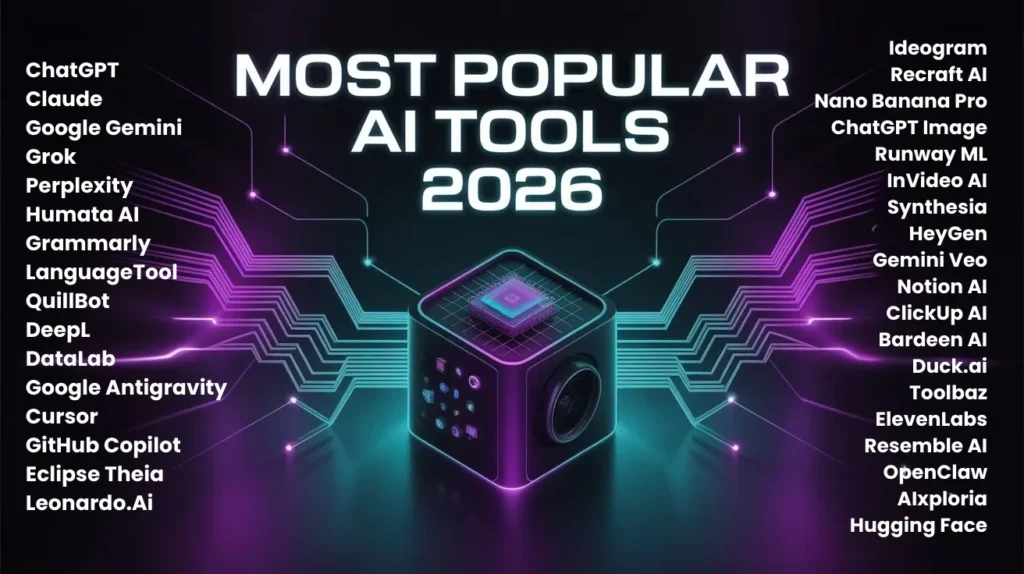
35 Best Free AI Tools in 2026
Here you will get some tools that define a perfect blend of community-driven platform, freemium models, and open-source development that has made a remarkable position in the market. This blog introduces the top 35 best free AI tools that are currently available in the market. It has listed tools with the help of authentic research and real-life observations, making it truly relatable for the readers.
Writing, Language, and Content Creation
The category of writing assistance contains some of the most widely adopted free AI tools available. Each platform approaches the task differently, catering to distinct use cases, from long-form research to quick paraphrasing and multilingual communication.
1. ChatGPT
ChatGPT remains one of the most recognised and widely used free AI tools in the world and for good reason. Its free tier provides access to a genuinely capable conversational interface that handles a broad spectrum of writing tasks with consistency and clarity. Consider what it can do for you:
• Draft and refine blog posts, emails, reports, and scripts
• Generate structured outlines for academic or professional documents
• Assist with brainstorming, concept development, and idea generation
• Provide coding explanations and basic programming support
Its strength lies in accessibility. The interface is clean, the learning curve is minimal and the outputs are dependable enough to form the basis of a real content workflow. The free version is multimodal in expanding ways, making it a practical first port of call for most users.
2. Claude
Claude is currently one of the most professional AI tools. IT stands apart in the category of best free AI tools, as it offers clear and contextual depth, which many competitors fail to do. While several AI writing tools produce responses that feel robotic or over-structured, the output that Claude gives tends to read with higher nuance. Below are some of the special features that make Claude stand out amongst the best AI tools:
• Handles long-document analysis and summarisation with precision
• Produces well-structured responses without unnecessary padding
• Free tier usage limits are comparatively generous
• Particularly effective for research synthesis and detailed analytical writing
For professionals who require both clarity and depth in their AI-assisted writing, without immediately committing to a paid plan, Claude represents a well-considered choice.
3. Google Gemini
Google Gemini earns its place among the best free AI tools primarily through its integration with the broader Google ecosystem. If your professional life already runs through Google Workspace, Gemini slots into your existing tools without friction. Practical strengths include:
• Real-time assistance within Google Docs, Gmail and Sheets
• Text and image understanding through multimodal features
• Summarisation and drafting directly within familiar interfaces
For users already embedded in Google’s suite of applications, Gemini reduces the friction of AI adoption considerably. It brings intelligent assistance into tools people already use every day, without requiring a separate workflow.
4. Grok
Grok occupies an interesting position among the best free AI tools as a newer entrant that prioritises real-time conversational responses and updated information streams. It performs particularly well in analytical discussions, scenario-based problem solving and research contexts that benefit from direct, concise responses.
- Real-time conversational AI with continuously updated information streams
- Strong analytical discussion and logical reasoning capabilities
- Highly effective for complex scenario-based problem-solving tasks
- Useful for research, insights and knowledge exploration
- Provides direct, concise and context-aware AI responses
- Competitive alternative to many established AI platforms
For users testing alternatives to established platforms, Grok offers genuine competitive value and continues to develop its feature set at pace.
5. Perplexity
Perplexity distinguishes itself from other best free AI tools by functioning less like a chatbot and more like an intelligent, cited research assistant. The fundamental difference: every response includes referenced sources, which makes it considerably more suitable for academic or business research where credibility matters. Key advantages:
• Generates structured, source-linked answers to research queries
• Interface is clean and purpose-built for focused information retrieval
• Free version is fully functional for daily research use
If fact-based, verifiable answers are a priority, Perplexity is among the most practically useful best free AI tools available.
6. Humata AI
Humata AI addresses a specific and common professional need: working with lengthy PDF documents. Rather than reading through a 60-page report manually, Humata enables users to upload the document and query it directly. This makes it one of the most time-efficient and best free AI tools for document-heavy workflows. It is particularly valued by:
• Researchers managing large volumes of academic literature
• Analysts reviewing lengthy technical or financial reports
• Students processing complex reading materials efficiently
The free tier provides the core document interaction features without unnecessary complexity, making it immediately useful rather than requiring extensive setup.
7. Grammarly
Grammarly has been a fixture in professional writing workflows long enough that it has earned a reputation for reliability and it continues to belong on any comprehensive list of best free AI tools. The free plan is more functional than many users assume:
• Grammar and punctuation correction in real time
• Tone detection and clarity recommendations
• Browser extension for corrections across all writing environments
• Suitable for academic, professional and creative writing contexts
While advanced features require an upgrade, the free tier is genuinely useful as a day-to-day writing companion.
8. LanguageTool
LanguageTool differentiates itself from Grammarly primarily through its multilingual support, making it one of the most distinctive best free AI tools for international professionals. It identifies grammar errors, punctuation inconsistencies and stylistic issues across a wide range of languages.
- Reliable proofreading tool for multilingual professionals
- Helps maintain consistent writing quality across languages
- Free alternative to premium grammar checking tools
- Suitable for international communication and professional writing
For professionals who communicate in more than one language. Who cannot afford to compromise on quality in either, LanguageTool provides reliable proofreading without requiring a paid subscription.
9. QuillBot
QuillBot has carved out a specific and well-recognized niche among the best free AI tools: paraphrasing and intelligent rewriting. For writers, students, and marketers who need to communicate the same idea in a different way, without losing its original meaning, QuillBot offers structured rewriting modes that adjust tone, simplify language, or enhance clarity.
- Advanced paraphrasing tool for rewriting sentences and paragraphs
- Multiple rewriting modes to adjust tone and clarity
- Helps simplify language while preserving original meaning
- Useful for writers, students, and marketing professionals
- Improves readability and overall content writing quality
- The free version offers limited but practical word count usage
The free version provides limited but practical word-count allowances and its value as a complementary writing tool is difficult to dispute.
10. DeepL
Translation quality varies enormously across platforms and DeepL’s reputation as one of the best free AI tools in its category rests on a consistent record of accuracy, nuance preservation, and contextual sensitivity. Unlike many translation tools that produce technically correct but tonally flat output, DeepL tends to produce translations that read naturally. Features worth noting:
• Preserves nuance and idiomatic language across multiple languages
• Offers formal and informal tone variations in select languages
• The free tier covers generous translation limits for daily business communication
For companies or professionals engaged in cross-border communication, DeepL removes a significant and often underestimated barrier.
Coding and Development
The development category has seen particularly rapid evolution in the best free AI tools space. Code generation, intelligent editing environments and AI-assisted completions have fundamentally changed how developers approach both daily tasks and larger projects.
11. DataLab
DataLab serves data science professionals and students as one of the more accessible best free AI tools in the analytics space. Its browser-based notebook environment removes the need for complex local installations and its AI assistance layer helps users generate Python code, interpret datasets and visualise results.
- Browser-based notebook environment designed for smooth data analysis workflows
- Eliminates the need for complex local installations or software setup
- AI assistance helps generate Python code quickly and accurately
- Supports easy interpretation of datasets and extraction of insights
- Built-in tools for clear data visualisation and result presentation
- Useful platform for both data science students and professionals
Whether you are learning data science or simply need a quick, guided environment for analysis work, DataLab lowers the barrier to entry considerably.
12. Google Antigravity
Google’s antigravity is consistently emerging as one of the most notable tools among the best free AI tools for software development environments. Functioning in an AI-driven integrated development environment, it constantly support application generation, automated testing workflow and code writing.
- AI-driven integrated development environment for modern software development
- Supports automated code writing and intelligent code suggestions
- Helps generate applications quickly with AI assistance
- Built-in support for automated testing and development workflows
For high-end developers who experiment with the agent-based coding approach, Antigravity offers an impressive and freely accessible platform.
13. Cursor
Cursor represents a step forward in what a code editor can be. Rather than offering isolated suggestions, Cursor understands project-wide context, which makes it one of the more practically useful best free AI tools for working developers. Highlights include:
• Real-time code suggestions and intelligent refactoring
• Context-aware edits that account for the broader project structure
• The free tier provides sufficient access for testing and small-scale development
It is particularly effective for rapid iteration and debugging and developers who try it often find it difficult to return to traditional editors.
14. GitHub Copilot
GitHub Copilot has established itself as one of the most widely recognised best free AI tools in the development space. Its limited free access tier still provides genuinely useful code completions and its deep integration into development environments makes adoption seamless. It benefits:
• Beginners learning syntax through contextual suggestions
• Experienced developers accelerating repetitive coding tasks
• Documentation writing and code commenting workflows
Even the free version demonstrates what AI-assisted development can look like in practice and it remains one of the most practical introductions to the category.
15. Eclipse Theia
Eclipse Theia differs from the other entries in this section in that it is not exclusively an AI tool; it is a modular, open-source development platform that supports AI extensions and intelligent integrations. For development teams or organizations that require scalable, customizable IDE solutions without licensing costs,
- Modular open-source development platform for customizable IDE environments
- Supports AI extensions and intelligent development integrations
- Highly scalable solution for enterprise-level software development teams
- Flexible architecture allowing deep customization and tool integration
Theia’s extensibility is its primary asset. It occupies a specific and valuable position among the best free AI tools for enterprise-level development environments.
Image Generation and Visual Design
Visual content creation has been transformed by the best free AI tools available in this category. What previously required professional design skills or expensive software can now be prototyped, tested and in many cases finalized using free platforms.
16. Leonardo.Ai
Leonardo.Ai has established a strong reputation among the best free AI tools for image generation, particularly for users who need detailed creative control over their outputs. The free credit allocation is genuinely useful for testing:
• Custom artistic styles and prompt engineering approaches
• Game assets, character designs and environment concepts
• Marketing visuals and product illustration concepts
The level of output quality available on the free tier is impressive and for creatives who need to experiment before committing, Leonardo provides a compelling starting point.
17. Ideogram
Ideogram solves a problem that most image generation tools handle poorly: accurate text within visuals. For designers creating posters, promotional materials, logos, or branded content where typography is a central design element, Ideogram is one of the most practically useful best free AI tools in the visual category.
- Useful for designers creating marketing and promotional materials
- Prompt enhancement improves creative briefs and instructions
- Produces cleaner, more polished visual outputs from prompts
- Practical tool for design, branding, and visual content creation
The prompt enhancement features also help users improve their creative briefs, resulting in more accurate and polished outputs.
18. Recraft AI
Recraft AI occupies a distinct position among the best free AI tools by focusing on vector-based image creation rather than rasterised outputs. For designers and brand teams, this distinction matters significantly:
• Generates scalable SVG graphics, icons, and logo concepts
• Outputs are adaptable across print and digital applications
• Free tier provides sufficient exports for prototyping and concept work
For businesses and startups that need clean, professional graphic assets but lack the budget for dedicated design resources, Recraft addresses a real gap.
19. Nano Banana Pro
Nano Banana Pro operates within Google’s AI infrastructure and offers a structured image creation environment with multilingual prompt support and stylistic customisation. As part of a broader AI ecosystem, it benefits from integration continuity. Some of the key features that Nano Banana offers to their users are:
- AI image generation within Google’s integrated ecosystem
- Supports multilingual prompts for flexible creative input
- Offers stylistic customisation for unique visual outputs
- Structured environment for controlled image creation
- Useful for early-stage design concept experimentation
The free tier is well-suited to designers in early concept stages who want to test creative directions before investing further time or resources in a project.
20. ChatGPT Image
ChatGPT Image integrates visual generation directly into the ChatGPT conversational interface, making it one of the most frictionless best free AI tools for users who want to move between text and image creation within a single workflow.
- AI image generation integrated directly within ChatGPT interface
- Seamlessly switches between text prompts and visual creation
- Generates images from natural conversational descriptions easily
Describing a scene naturally and receiving a corresponding visual output, with the ability to refine through conversation, simplifies the creative process for users without specialist design skills.
Video Creation and Editing
Video production has long demanded considerable resources, specialised equipment, trained personnel and expensive editing software. The emergence of capable free tools in this category has changed that equation, opening the door for individuals and lean teams to produce work that once required a fully staffed production environment.
21. Runway ML
Runway ML distinguishes itself through the sheer range of what its free plan makes available. Users gain access to credits that support genuine experimentation across several functions: generating video footage from text descriptions, removing backgrounds and tracking motion and working within AI-assisted editing pipelines. Content creators, marketers and independent filmmakers have adopted Runway primarily to reduce both the time and the technical skill required to produce polished output. It performs particularly well for short-form content, where the relationship between effort invested and quality returned matters most.
22. InVideo AI
InVideo AI is a well-known video-generating platform. This can easily convert a written text into well-structured video content, complete with scene sections, pacing and also AI-generated voiceovers. The free version of this tool applies a watermark to exports, which makes it easy for tasks like concept development and early-stage drafts. It serves well for promotional and explainer videos, social media content, and rapid prototyping before committing to a full production process. By automating scripting and scene assembly, it removes the steepest barriers for those without a dedicated video editing background.
23. Synthesia
Synthesia addresses a specific challenge: producing presenter-style video without cameras, studios, or on-screen talent. Using AI avatars and automated voiceovers, the platform removes several of the most persistent barriers to corporate video creation. Organisations producing training materials, onboarding programmes, or internal communications at volume will find it among the more practically useful tools in this category. The demo tier provides enough access to form a well-grounded assessment of its capabilities.
24. HeyGen
HeyGen specialises in personalised AI spokesperson videos, using automated lip-sync to produce talking-head-style content from written scripts. The free credit allocation is suited to small-scale experimentation and prototype development rather than sustained production. Marketers and educators find it useful for quick announcements, tutorial content and personalised communication at scale, without requiring presenter availability, camera equipment or complex post-production work.
25. Gemini Veo
Gemini Veo brings AI-assisted video generation into Google’s broader product ecosystem, enabling users to produce short video clips from descriptive text prompts. Its integration with other Gemini features supports consistency across multimodal workflows. For concept visualisation and creative exploration, particularly for teams already embedded within Google’s suite of tools, like Gemini VEO, it is a meaningful addition to this category.
Productivity, Automation and Research
The tools covered in this section apply AI to the management of tasks, information and operational workflows. Their focus is efficiency rather than creation and in many professional contexts, this is where the return on time invested is highest.
26. Notion AI
Notion AI introduces AI assistance into one of the most widely adopted knowledge management environments available. Within a Notion workspace, users can call on it to summarise notes and meeting records, draft documents and project plans and interact intelligently with databases. AI assistance fully integrated within the Notion workspace environment:
- Quickly summarises notes, meetings and long documents with clarity
- Helps draft documents, reports, ideas and detailed project plans
- Smart interaction with databases and organised workspace content
- Improves team productivity, collaboration and overall workflow efficiency
- A free tier available with limited but useful AI responses
The free tier restricts the volume of AI responses but provides sufficient access to determine whether it genuinely improves a team’s workflow before any financial commitment is made. For organisations already using Notion as their central operational hub, the addition of AI is a logical extension.
27. ClickUp AI
ClickUp AI extends the platform’s existing project management capabilities with intelligent automation and content generation. It assists with task summaries, documentation drafting and workflow optimisation within the ClickUp environment. For smaller teams managing complex coordination requirements, the introductory AI access on the free plan offers a useful introduction to AI-supported project management without requiring an upfront investment.
28. Bardeen AI
Bardeen AI occupies a specific and valuable position: browser-based automation that requires no coding knowledge. It enables users to automate repetitive online tasks, extract data, generate leads and sync workflows through an accessible interface. Professionals in sales, research and content operations find it particularly effective for reducing manual effort without involving a developer. The free plan provides a reasonable starting point for personal productivity automation.
29. Duck.ai
Duck.ai takes a distinctly different approach from most of the tools in this guide: it prioritises user privacy at a foundational level. Integrated within DuckDuckGo’s search environment, it supports conversational queries and information retrieval without mandatory account creation or behavioural tracking. For researchers and professionals for whom data privacy is a genuine concern, Duck.ai demonstrates that capable AI assistance and user confidentiality can coexist without compromise.
30. Toolbaz
Toolbaz is a fully functional AI tool specifically made for content writing and polishing. This placement bridges together the AI-powered writing utilities and generators for blog topics and SEO outlets. Output will often require an editorial refinement for official publications, but it successfully accelerates the early drafting phase of the content. For independent creators or startups who need to work faster without extending the budget for premium tools, Toolbaz can be an optimum choice.
Audio and Voice Generation
The audio category has undergone significant development in recent years. Text-to-speech and voice synthesis technologies that were clearly artificial just a few years ago now produce output that can be difficult to distinguish from recorded human narration.
31. ElevenLabs
ElevenLabs has established a consistent reputation for the quality of its text-to-speech generation and the standard of its voice outputs is the primary reason. The free credit allocation permits meaningful experimentation with lifelike narration across a range of applications: podcast production, audiobook narration, e-learning materials and video voiceovers. The natural intonation and tonal accuracy of ElevenLabs voices make the free tier a genuine representation of what professional-grade AI audio can deliver and for creators evaluating platforms in this space, it sets a high benchmark.
32. Resemble AI
Resemble AI focuses specifically on voice cloning and synthetic speech personalisation, making it a more specialised entry in the audio category. The free tier allows limited testing of voice replication capabilities, which is particularly valuable for brand voice development and consistency testing, building prototype audio content for products or applications and developers exploring voice personalisation technology for the first time. Its editing dashboard supports speech adjustment and customisation, giving users meaningful control over the characteristics of the final output.
Open-Source, Agent-Based, and Discovery Tools
The final category includes some of the most technically substantive tools available, platforms that support autonomous AI agents, facilitate the discovery of new tools, and provide the foundational infrastructure on which much of the broader AI ecosystem has been constructed.
33. OpenClaw
OpenClaw is an open-source autonomous AI agent framework that enables users to experiment with multi-step task automation and intelligent execution pipelines. Its open architecture is transparent and customisable, qualities that researchers and developers who need to understand and control their AI systems tend to value significantly. As interest in agent-based approaches continues to grow across the industry, OpenClaw provides a practically useful and technically honest entry point into the space.
34. AIxploria
AIxploria serves a different but equally important function: it operates as a comprehensive, categorised directory of AI platforms rather than being a platform in its own right. For entrepreneurs, researchers and professionals who need to identify specific tools for niche applications, its organised structure makes discovery considerably more efficient than broad searching. Users can filter by industry, function, or popularity and identify emerging options that might otherwise go unnoticed in a rapidly expanding market.
35. Hugging Face
Hugging Face closes this list as arguably the most foundational resource for technical users working seriously with AI. As the leading open-source AI community platform, it hosts thousands of pre-trained models across natural language processing, computer vision and audio tasks. Developers can access, adapt and deploy models freely and the platform actively supports collaborative development and large-scale experimentation. Its significance stems from several factors: the breadth of pre-trained models available for immediate use, the active global community driving continuous innovation, the infrastructure that enables flexible and scalable AI development and free access to tools and models that underpin many commercial applications. For any developer or researcher working seriously with machine learning, Hugging Face is not simply one option among many, it is a fundamental and largely irreplaceable resource.
Trends and Why These Tools Matter
The 35 platforms documented above represent more than a useful collection of software. They reflect several converging developments that are reshaping how individuals and organisations engage with artificial intelligence in 2026.
The most significant of these is genuine accessibility. The best free tools available today are not artificially limited versions of commercial products designed to pressure users into upgrading. Many deliver real, substantive capability within their free tiers. The gap between what paid and free access provides has narrowed considerably and in specific use cases, free tools outperform premium alternatives outright.
The second trend is multimodality. An increasing number of leading tools are no longer single-function platforms. Tools that began with text generation now handle images, audio and video. Tools built for code editing are developing research and documentation capabilities. This convergence makes integrated AI workflows achievable without assembling a large collection of disconnected applications.
Third, ease of use has become a genuine design priority rather than an afterthought. Interfaces are cleaner, onboarding is faster and the assumption that AI tools are the exclusive domain of technical users has been largely discarded. Almost without exception, the platforms in this guide are accessible to both professionals and those new to the space, often through the same interface and without a steep learning curve.
Finally, community-driven innovation continues to accelerate development in ways that purely commercial models cannot replicate. Open-source platforms such as Hugging Face and OpenClaw evolve rapidly, driven by researchers and developers who share improvements freely. This produces collective progress that often outpaces what proprietary development cycles can deliver.
How to Choose the Right Tools
With 35 options presented here and considerably more available beyond this guide, the practical question becomes one of selection. A few principles can provide useful direction.
Start with your objective. Define the specific task clearly before selecting a tool. Whether the goal is writing more effectively, coding faster, producing video or automating repetitive processes, a clear answer to that question narrows the field considerably.
Match tools to tasks deliberately. Resist adopting several tools simultaneously. Select one platform per category, invest sufficient time in understanding it properly and expand only when there is a clear reason to do so.
Understand the constraints of free access. Free tiers carry usage limits, export watermarks and feature restrictions. These are not obstacles to work around; they reflect the expected structure of a freemium model. Plan usage accordingly and upgrade when the return justifies the cost.
Combine tools with purpose. Some of the most effective AI workflows are built from complementary platforms used together. Using one tool for research and another for drafting, for instance, allows each to operate within its area of strength without wasting usage credits on tasks the other handles more efficiently.
Review choices regularly. This landscape changes quickly. A tool well-suited to your needs today may be surpassed within months. Staying informed about new entrant structured directories can help here, ensuring that your workflow remains genuinely optimised rather than simply familiar.
Final Thoughts
The year 2026 marks a meaningful shift in what is practically available without financial commitment. Access to capable, reliable AI assistance no longer requires significant expenditure. Whether you are a student strengthening your research practice, a creator building a content business, a developer seeking to accelerate output, or a business leader evaluating automation opportunities, the tools documented in this guide provide a credible and practical starting point.
The most important action is also the most straightforward: select one tool relevant to a current task and use it consistently enough to form a clear picture of what it can and cannot do. From that foundation, building a broader and more capable AI-supported workflow becomes considerably more achievable.
The best free tools available in 2026 are not a temporary compromise on the path to paid software. For a wide range of use cases, they are the right tool for the task and that represents a significant shift in what is possible for anyone willing to invest the time to use them consistently.