

OpenAI stated that ChatGPT would start testing advertisements in the U.S., which would be a breakthrough in the monetization of generative AI interfaces. Ads placed in an AI chat platform will set the stage for a new type of advertising that would cater to the users of conversational AI based on their specific needs. This launch can be seen as a blessing or a challenge, depending on the position of the various parties involved: users, advertisers, and digital marketers.
The piece delineates the ad tests, their workings, and their significance, along with the tactics that can be employed by brands to take advantage of the new format. Moreover, it presents its users with a brief FAQ section to quickly sort through the most important points.
Source: Search Engine Journal — ChatGPT to Begin Testing Ads in the United States.
Why Ads Are Coming to ChatGPT
ChatGPT was initially released as a no-cost, conversational AI tool. Gradually, OpenAI rolled out paid versions like ChatGPT Plus and enterprise services. Besides, the company’s other source of income, which is through advertisement, could turn AI applications into more environmentally friendly and widespread tools, besides enabling advertisers to come close to active users in interactive searches and thus helping them reach the audience they are looking for.
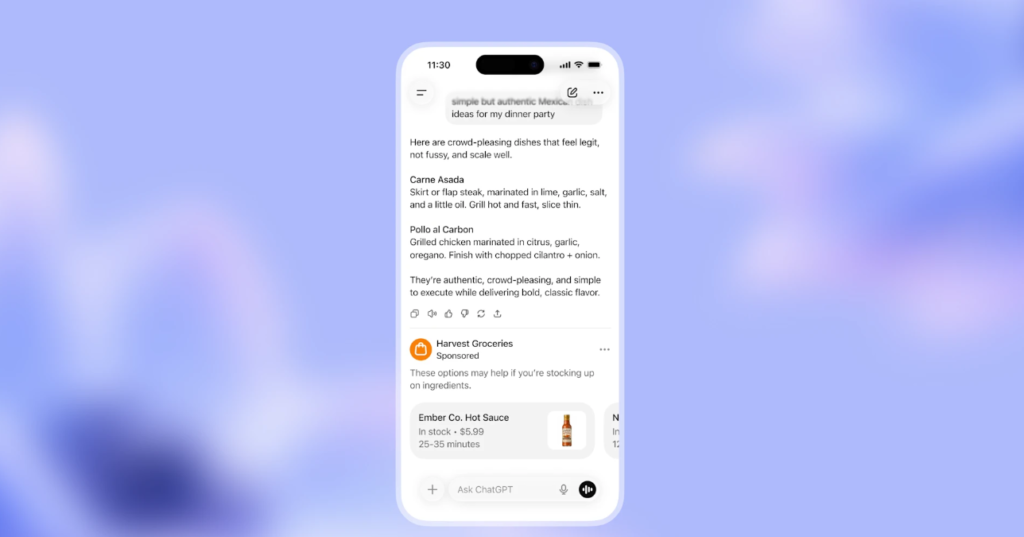
OpenAI’s decision to test ads reflects a broader trend: digital products with high user engagement are incorporating advertising in novel, non-traditional ways. With AI assistant use surging, chat-based results are becoming a destination in their own right — similar to search engines or social feeds.
What the Ad Test Will Look Like
According to the announcement, the initial ad tests will:
- Launch only in the United States
- Appear in the free version of ChatGPT
- Display ads alongside responses when relevant
OpenAI emphasizes that the test is experimental and limited, and that ads will be contextual rather than disruptive. The initial placements are expected to resemble familiar digital ad formats — short, labeled responses or sponsored suggestions — integrated into the chat flow rather than interrupting conversations.
Early examples suggest ads will be presented when useful and special disclosure labels will indicate paid content. This resembles how search engines distinguish “sponsored results” from organic answers.
How Ads Fit in an AI Experience
Unlike traditional search, ChatGPT provides conversational summaries, recommendations, and answers instead of lists of links. Advertising in this environment must balance relevance with user experience.
Here are some possible ways ads may appear:
- Contextual product recommendations: Based on the query, ads could offer product links related to an answer.
- Sponsored insights: Brief, labeled guidance supporting a recommendation.
- Call-to-action suggestions: Ads enticing users to take a next step — such as “visit site for more details” or “learn about this offer.”
What distinguishes ads in ChatGPT from search ads:
- They could appear inside responses, not just at top/bottom positions.
- They may tie more directly to conversational context, not just keyword matching.
- They require careful labeling to avoid confusing paid content with AI’s primary answer.
This context-aware integration is both a technical and ethical challenge.
Why This Matters for Users
Users benefit from contextual suggestions that feel natural within a conversation. If done well, ads can:
- Help find products or services without switching tabs
- Provide timely offers related to a user’s query
- Reduce friction in research-to-purchase journeys
However, there are concerns:
- Users might mistakenly take ads as organic recommendations
- Misleading or poorly labeled ads could erode trust
- Ad clutter might degrade conversational quality
Ensuring ad transparency and relevance is critical. Early testing will likely explore how to balance monetization with conversational integrity.
Why This Matters for Advertisers
For advertisers, ChatGPT ads introduce a new channel with unique advantages:
- Highly engaged audience: Users interacting with AI are often seeking precise information — a context that indicates strong intent.
- Contextual relevance: Ads tied to questions can be highly targeted based on intent, not just keywords.
- Early mover advantage: Brands experimenting early may gain visibility and insights before the ad format matures.
Advertisers could see benefits similar to early search ads: high intent + relevance = conversion opportunities.
Potential Use Cases for AI Ads
Here are some examples of how ChatGPT ads could work in real scenarios:
Product Discovery
A user asks
“What’s the best wireless noise-cancelling headphone under $300?”
ChatGPT could share a list of top models — followed by sponsored recommendations from brands that pay for placement, clearly labeled and contextual.
Travel and Booking
User:
“Where should I stay in New Orleans during Jazz Fest?”
AI responds with tips — and may include sponsored hotel suggestions that match the travel date and preferences.
Software Tools
User:
“What tools help with remote team collaboration?”
AI could provide comparison insights, followed by sponsored entries for tools that pay for visibility.
In these cases, users still receive value while brands gain exposure in a high-intent environment.
Challenges Ahead
1. Balancing Ads and Trust
AI systems need to avoid pay-to-play bias, where paid content overshadows accuracy or relevance. Users should never be misled into thinking ads are organic AI answers.
2. Labeling and Transparency
Clear labeling of sponsored content is legally and ethically necessary. Confusing paid suggestions with impartial answers could damage brand and platform trust.
3. Ad Quality and Relevance
Poorly targeted or low-quality ads could degrade user experience. AI systems must evaluate both relevance and usefulness before presenting ads.
4. Measurement and Attribution
Advertisers will need new ways to measure AI ad performance. Traditional metrics like CTR or session duration may need adjustment for conversational formats.
Industry Reactions and Broader Context
Digital marketing communities have responded with interest and caution. Many see AI ads as a logical next step, while others stress user experience risks:
- Advertisers anticipate a new performance channel with potentially strong intent signals.
- Marketers note that AI ads could reduce dependence on traditional search ads over time.
- Privacy advocates highlight concerns about how personalization will work without compromising user data.
This trend mirrors broader industry movements toward AI-mediated discovery — where search and recommendation engines become less link-centric and more conversational.
Comparison to Traditional Search Ads
| Feature | Search Ads | ChatGPT AI Ads |
| Placement | Top/bottom of SERP | Within an AI conversation |
| Targeting | Keywords/intent | Contextual + conversational cues |
| User Intent | Search queries | Dialogue + intent evolution |
| Measurement | CTR, CPC, conversion | NLU-driven engagement metrics |
| Integration | Separate from results | Native to answers |
ChatGPT ads can feel more integrated than search ads, but this increase in contextual relevance brings added responsibility.
Strategies for Advertisers Entering AI Ads
To make the most of ChatGPT ad testing, advertisers should consider:
1. Prioritize Intent-Aligned Creative
Focus on how users phrase questions rather than just keywords. Conversational intent should shape ad creative and calls to action.
2. Optimize for Relevance, Not Disruption
Ads should enhance, not interrupt, the user’s conversational flow.
3. Monitor Early Performance Closely
Since AI ad formats are new, initial data will be key. Metrics might include:
- AI ad engagement rate
- conversion rate from AI suggestions
- user feedback sentiment
Tracking these will help refine campaigns before broader rollout.
4. Test Across Use Cases
Deploy ads linked to:
- Product recommendations
- Local services
- Software tools
- Events and travel
This variety helps identify where AI ads perform best.
Regulatory and Ethical Considerations
As AI ads emerge, oversight will be important:
- FTC guidelines require clear disclosure of sponsored content.
- Platforms must avoid deceptive practices where ads look like organic answers.
- Data privacy rules must be respected, especially if personalization is involved.
Consumer protection groups may push for explainability around why an ad is shown and how personalization works.
FAQs: ChatGPT Ads in the United States
Q1: What exactly is being tested?
OpenAI is testing advertisements in ChatGPT in the United States, initially in the free version, where ads are shown alongside AI responses.
Q2: Will ads look like search results?
No ads in ChatGPT are expected to be contextual suggestions integrated into the conversation and clearly labeled as sponsored content.
Q3: Does this affect paid ChatGPT plans?
The initial tests target the free tier of ChatGPT. OpenAI has not announced changes to premium subscription offerings linked to ads.
Q4: How should businesses prepare?
Advertisers should start exploring AI-oriented ad strategies, build intent-aligned creative, and monitor metrics specific to AI engagement.
Q5: Are user data and privacy affected?
Ads will be contextual and should not require new personal data beyond what users already provide in conversation. Platforms must still comply with privacy laws.
Conclusion: A New Era for Conversational Advertising
Ad testing in ChatGPT signifies a major change in the digital advertising industry. OpenAI is facilitating the fusion of chatbots and advertising, which is a breakthrough for brands to reach consumers during the search and discovery phases. Such a change compels marketers to reconsider their strategies concerning keywords and to optimize for conversation, context, and user intent at the same time.
Engaging ads can act as a good recommendation source for users, provided they are not disturbing the flow of conversation. However, the trust issue will depend on the factors of transparency and quality.
The companies that will be able to make the most of the new advertising panorama will be the ones that take the lead — concentrating on user experience and intention alignment — when the testing phase is completed, and the formats are more developed.
As a trusted web development company in India, we deliver secure, scalable, and high-performing web solutions. If you’re looking for reliable web development services in India, contact us today to start building your digital success.