
The digital world is developing very quickly, and the key to this transformation is immersive technologies. Among them, AR and VR technology is redefining how people interact with content, businesses, and digital environments. Users can now have access to information in interactive and immersive forms as opposed to just merely seeing the information on screens.
In the retail and healthcare industries, as well as in banking and education sectors, such technologies are developing a whole new set of digital interaction. Learning about the distinctions between AR and VR, as well as their currently existing applications could assist enterprises and buyers in staying on track of the next level of digital experience.
What Are AR and VR?
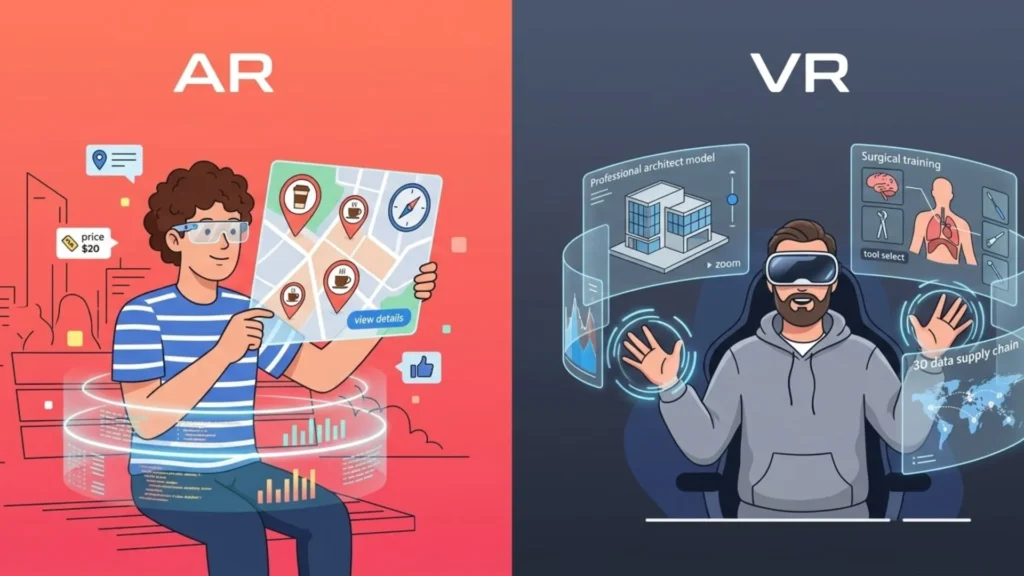
AR is an improvement of the physical world with an addition of digital features like images, text, or animation with the use of smartphones, tablets, or smart glasses. It is not a substitute of reality but it improves it.
On the contrary, Virtual Reality involves the user into entirely digital environment by the use of headsets. The actual world is no more, and users are communicating in a completely simulated environment.
Both technologies are similar to immersive computing and they are quickly improving with the availability and increasing power of hardware.
AR vs VR: Key Differences at a Glance
The easiest way to understand the distinction between these technologies is by comparing how they function and where they are typically used.
| Feature | Augmented Reality (AR) | Virtual Reality (VR) |
| Environment | Enhances the real world with digital overlays | Completely replaces the real world |
| Devices Used | Smartphones, tablets, smart glasses | VR headsets and motion controllers |
| User Awareness | Users remain aware of their surroundings | Users are fully immersed in a digital environment |
| Popular Use Cases | Retail visualization, navigation, education | Gaming, simulations, training |
| Example | Pokémon GO | VR experiences on devices like Meta Quest 3 |
Understanding this difference is essential for businesses deciding how to implement AR and VR technology into their digital strategies.
Why AR and VR Are Becoming Essential for Digital Experiences
The rapid growth of AR and VR technology is not accidental. It is propelled by a number of core benefits that their traditional online platforms are unable to provide.
To begin with, immersive experiences have a strong dramatic effect on the level of user engagement. When the users are able to become associated with the digital environment and not just watch it, the level of their attention and retention is high.
Second, decision making is enhanced by these technologies. In e-commerce, buyers are able to have a visual representation of the products in a real life setting before making a purchase to cut on uncertainty and returns.
Third, immersive technologies can be used to powerfully train. VR simulations have been applied in such industries as aviation, healthcare, and manufacturing to train employees in the simulated real-life without taking real-life risks.
Technology companies such as Apple and Meta Platforms are investing heavily in immersive computing, highlighting the strategic importance of AR and VR technology for the future digital ecosystem.
Real-World Applications Transforming Industries
Retail and E-commerce
Retailers have embraced AR application which enables them to see how furniture, clothes, or cosmetics look prior to their arrival in the living room, bedroom, or bedroom before they are purchased. This makes shopping more interactive and it also enhances confidence in buyers.
Health and Medical Schooling.
Surgery simulators are being used in VR to train medical practitioners on how to perform complicated procedures and surgeries in safe conditions. Surgeons are also being assisted by AR to superimpose patient data on top of the operation.
Education and Learning
The immersive classrooms are increasingly becoming common. By means of it, students may visit historical sites, perform virtual science experiments, or learn using 3D content.
Banking and Financial services.
Banking banks are also considering immersion-style virtual banking branches and immersive financial education. Future banking interfaces may allow users to visualize investments or financial planning in 3D dashboards using AR and VR technology.
Market Growth and Future Potential
The immersive technology market is developing very fast around the world. Analysts in the industry have forecasted that the AR and VR industry may have a valuation of more than 100 billion in the next 10 years.
Key products like Apple Vision Pro indicate how the immersive products are going beyond entertainment to be productive, being able to communicate and work.
As hardware becomes lighter, cheaper, and more powerful, AR and VR technology will likely become as common as smartphones are today.
Difficulties Slowing Down Adoption.
Despite the potential, it has a number of challenges due to which its large-scale adoption remains affected.
- High prices of the devices remain to be one of the greatest barriers to consumers and the businesses. Advanced headsets and spatial computing remain expensive to be available to masses of people.
- The other threat is comfort and usability. Some users and developers are attempting to correct the situation as long VR sessions can be boring or can cause motion sickness.
- The issue of privacy is also liable to concern because the immersive devices are capturing fine behavioral and spatial data.
- Addressing these challenges will be critical for the long-term success of AR and VR technology.
Immersive Digital Interaction in the Future.
The online communication is likely to develop beyond the flat screens to areas and immersion. With the introduction of artificial intelligence, high internet connection, and the improvement of hardware, immersive platforms will become even more of a commonality in everyday life.
Whether it is virtual workplaces, immersive education platforms, or interactive shopping environments, AR and VR technology is set to redefine how people experience the digital world.
The companies that will have a massive competitive advantage in the new era of digital transformation will be the ones that can adopt such technologies in the near future.