
The All-in-One SEO (AIOSEO) plugin for WordPress, which is known as one of the most popular SEO tools with over 3 million installations, was reported to harbor a security flaw that could reveal confidential credentials and allow the unauthorized use of AI functionalities. The vulnerability was swiftly fixed but at the same time raised the alarm regarding the continuous threat that third-party plugins pose to WordPress site’s security, and it also pointed out the necessity of regular updates and access control practices as key measures.
This article serves as a complete, current, and SEO-friendly summary of the vulnerability, its mechanism, significance, and resolution. Besides, it explains what actions site owners and developers must take now. The presentation is such that it focuses on clarity and long-term search visibility, with the use of headings, brief FAQ replies, and practical tips.
What Is All in One SEO and Why It Matters
All in One SEO (AIOSEO) is a popular WordPress plugin used by over three million websites to manage SEO tasks such as:
- Generating metadata for posts and pages
- Creating XML sitemaps
- Adding structured data
- Providing AI-assisted tools for generating titles, descriptions, FAQs, social posts, and images
Its widespread use in both small blogs and business sites makes any security issue especially important — vulnerabilities in AIOSEO can put a large portion of the WordPress ecosystem at risk.
Details of the Recent Vulnerability
The vulnerability uncovered in 2026 affected all versions of AIOSEO up to and including version 4.9.2 and was fixed in version 4.9.3. It stemmed from a missing authorization check on a REST API endpoint. That flaw allowed users with relatively low privilege, such as those with Contributor roles, to retrieve a site’s global AI access token — a credential used by the plugin’s AI features.
Technical Explanation
The issue occurred in the REST endpoint:
/aioseo/v1/ai/credits
This route is meant to return information about AI usage and remaining credits. However, due to a missing capability check, any logged-in user with Contributor-level access or higher could access that endpoint and obtain the site’s AI token.
Why This Is a Problem
In WordPress, user roles are hierarchical. A Contributor can submit drafts but usually cannot perform administrative actions. Because AIOSEO did not verify whether a user had the appropriate permissions before returning the AI access token, even low-privilege users could extract it.
This token enables communication with AIOSEO’s external AI services and is effectively a site-wide credential. If an attacker obtains it, they could:
- Trigger unauthorized AI requests, generating content or consuming credits on behalf of the site
- Deplete available AI credits, denying legitimate administrators access
- Potentially script automation to exhaust or abuse AI-related services
Although the flaw did not allow direct code execution or full site compromise by itself, the unauthorized exposure of sensitive keys presents a serious billing and misuse risk.
Historical Vulnerabilities in AIOSEO
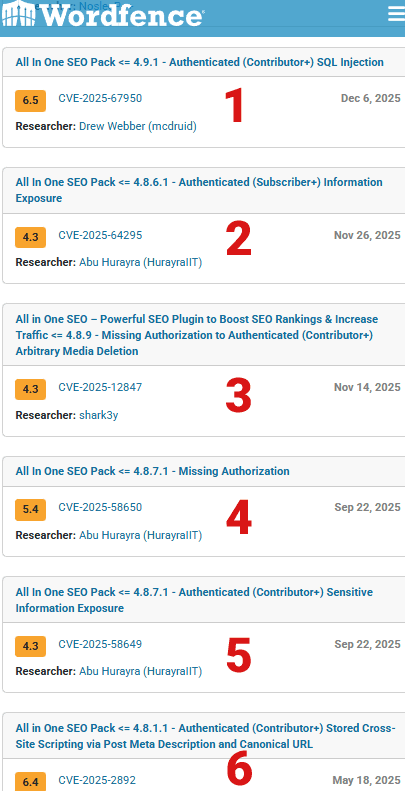
The 2026 vulnerability is not the first security issue discovered in the plugin. Previous reports show a pattern of authorization and information exposure concerns:
- In 2023, two Stored Cross-Site Scripting (XSS) vulnerabilities affected versions up to 4.2.9, allowing attackers with Contributor access or higher to inject malicious scripts that execute in browsers viewing compromised pages.
- Other past exploits allowed privilege escalation and potential SQL injection, demonstrating recurring challenges with input validation and access control.
These historical issues emphasize the importance of sustained security practices and monitoring for third-party plugin vulnerabilities.
How the Vulnerability Was Resolved
The developers of All in One SEO responded promptly. The fix shipped in version 4.9.3, which included a security update described as:
“Hardened API routes to prevent AI access token from being exposed.”
This patch introduced the missing permission checks on the affected REST API endpoint, ensuring only authorized users (typically administrators or higher) can retrieve sensitive information like the AI token.
Site owners are strongly advised to ensure their installations are running version 4.9.3 or higher.
Immediate Actions for WordPress Site Owners
If your site uses All in One SEO, these steps will help protect it from this and similar threats:
1. Update the Plugin Immediately
Ensure AIOSEO is updated to version 4.9.3 or later. WordPress notifications usually show available updates, but you can also check from the Plugins dashboard.
2. Audit User Roles
Review user roles on your site. Limit Contributor and other privileges to trusted accounts only. Avoid granting roles higher than necessary.
3. Monitor API Usage
If your site integrates other services via REST APIs, periodically review access tokens and revoke or rotate keys that may have been exposed.
4. Review AI Token Usage
Check your AI service usage and credit logs. If suspicious activity occurred (e.g., unexpectedly high consumption), consider contacting the plugin developer and your AI service provider.
5. Harden WordPress Security
General measures include:
- Installing a security plugin with a firewall and malware scanning
- Enforcing strong passwords and two-factor authentication
- Keeping all plugins, themes, and WordPress core up to date
- Regularly backing up your site
Broader Implications for WordPress Plugin Security
The AIOSEO vulnerability highlights a broader pattern: REST API endpoints in WordPress are common vectors for exploitation when permission checks are missing or insufficient. As plugins interact with APIs for data and feature integration, rigorous authorization validation is critical.
Several lessons arise from this incident:
- Principle of least privilege: Plugins must enforce the minimum permission necessary for API access.
- Third-party dependencies: Popular plugins significantly broaden the attack surface; site owners must track vulnerabilities in widely deployed extensions.
- Continuous patching: Even well-maintained plugins can ship with overlooked security flaws; rapid patch adoption is essential.
Security researchers and plugin developers must collaborate closely to detect and address vulnerabilities early, and site owners must stay vigilant about updates.
Conclusion
The All-in-One SEO bug that impacted countless WordPress websites conclusively proved that plugin security is the chief factor in a website’s safety. The most commonly used and widely adopted tools might also have errors that leak authorization information or lessen the strength of the protection.
If the users act faster than the attackers by getting the patched version installed, renewing the user access and practicing hard security, the site owner can greatly minimize his/her risk. In a wider context, this event highlights the fact that it is very necessary to keep on monitoring third-party plug-in vulnerabilities because of the nature of WordPress security being a dynamic one.
As a trusted web development company in India, we deliver secure, scalable, and high-performing web solutions. If you’re looking for reliable web development services in India, contact us today to start building your digital success.
FAQs About the AIOSEO Vulnerability
Q1: What was the main issue with the All-in-One SEO plugin?
A missing authorization check on a REST API endpoint allowed users with Contributor-level access to retrieve the site’s global AI access token, exposing sensitive credentials.
Q2: How many sites were affected?
The plugin is active on more than 3 million WordPress sites, so all installations running vulnerable versions before 4.9.3 were at risk.
Q3: Does this vulnerability allow full site takeover?
No. While the exposed AI access token presents a misuse and credit depletion risk, the vulnerability did not allow direct code execution or full site takeover on its own. However, it could be part of a larger chain of attack vectors.
Q4: How do I protect my site now?
Update AIOSEO to version 4.9.3 or newer, review user roles, monitor AI usage, and follow general WordPress security best practices such as using firewalls and security plugins.
Q5: Are older vulnerabilities in AIOSEO still relevant?
Past vulnerabilities, such as Stored XSS flaws fixed in earlier versions, show recurring access control issues. Even though those are patched, they underscore the need for regular updates and security audits.