
Homes are transforming into smart living places that can predict the human requirements. Smart home technology is driving this transformation by connecting devices, appliances, and home systems through the Internet of Things (IoT). What previously seemed futuristic like voice-controlled lights, security by checking on your smartphone, or even the automation of the temperature system are being used now by few millions of households, and are a reality.
The modern house owners are not only embracing the technology for the sake of making life convenient, consumers are looking to find efficiency, security, and sustainability in their homes. The smart home system is experiencing fast growth all over the world as the digital infrastructure is being enhanced, and connected things are getting cheaper to acquire.
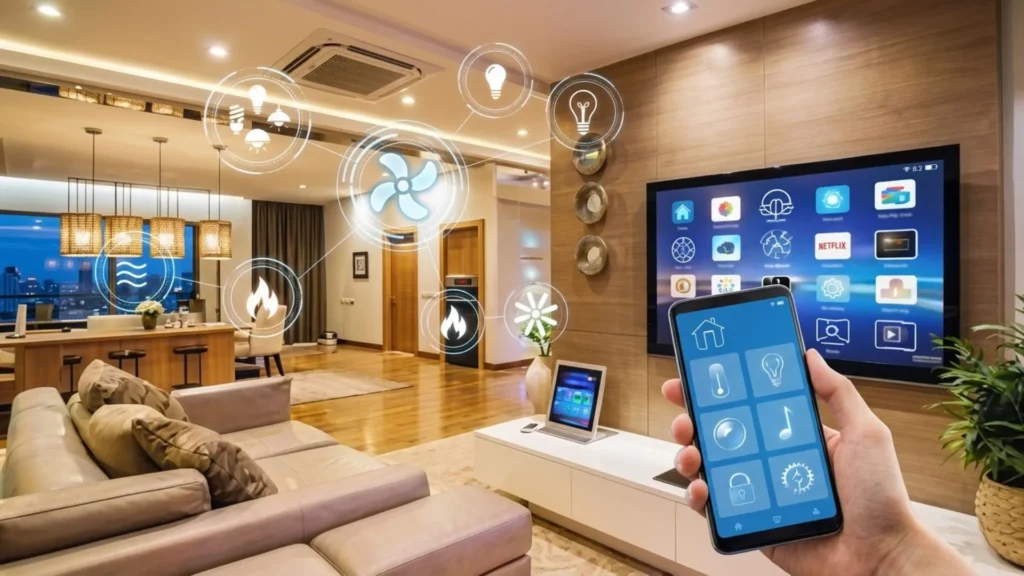
What Smart Home Technology Actually Means
At its core, smart home technology refers to an integrated network of connected devices that communicate with each other and can be controlled remotely. These tools are usually operated by the assistance of a mobile app, central hub or voice assistant.
A smart home today may comprise of smart lights, automatic climate controls, high tech security controls, voice-controlled assistive devices such as Alexa, smart refrigerations, smart garden irrigation etc. These technologies create a single digital platform in which the functionality in the house can be automated and optimized.
As an illustration, a homeowner can set up a schedule when the lighting is turned off in the morning and gradually turns on, and the thermostat is utilized that changes according to the outside of the temperature, and the cameras are turned on when no person is around.
The reason why Smart Homes fast have become common.
The worldwide transition to a connected lifestyle is driven by a number of technological and economic factors. Faster internet speeds, the advent of artificial intelligence and an infiltration of smartphone technology have made it easier for consumers to manage their digital ecosystems in their homes.
According to industrial predictions, the market size of smart homes in the world is expected to have more than 300 billion dollars by 2030 due to high demand in intelligent security systems, energy efficient gadgets and voice controlled automation. The so-called emerging markets are also expected to boost this growth because urban households are focusing more on convenience and safety.
Key Components of a Modern Smart Home
To understand the full potential of smart living, it is helpful to look at the core systems that form a connected home ecosystem.
Smart Home System | What It Does | Real-Life Benefit |
Smart Lighting | Allows remote or automated control of lights | Saves electricity and improves ambiance |
Smart Thermostat | Automatically regulates home temperature | Reduces energy bills and improves comfort |
Smart Security | Includes cameras, sensors, and door locks | Enhances safety with real-time alerts |
Voice Assistants | Controls devices using voice commands | Hands-free home management |
Smart Appliances | Connected refrigerators, ovens, and washing machines | Improves efficiency and convenience |
These systems work together to create an intelligent environment where everyday tasks become simpler and more efficient.
The Role of Artificial Intelligence in Smart Homes
Connected homes are becoming adaptable through artificial intelligence, which is changing them into non-complex remote-controlled homes. Smart devices can examine the behavior, preferences, and environmental information to make automatized decisions with the help of AI.
As an illustration, a smart thermostat can determine when individuals tend to get up, leave to work and come back to their households. It also regulates heating or cooling automatically in an attempt to ensure comfort over time and eliminate unnecessary energy consumption.
Voice assistants also use AI to a large extent to process commands using natural language and to manage several devices simultaneously. Rather than having to manually turn on a number of systems, a single command may be used to turn on a complete routine, like a good night mode, which locks the doors, switches off the lights, and lowers the thermostat.
Pros and Cons of Smart Home Technology
Smart home technology offers many benefits that make everyday living more convenient, efficient, and secure. But, just as any other new technology, it is also accompanied by some problems, that homeowners need to take into consideration before embarking on a fully connected system. The following table highlights the key advantages and potential drawbacks of smart home technology.
Pros | Cons |
Convenience and automation – Devices can be controlled through apps or voice commands. | Privacy concerns – Smart devices collect data about household activities. |
Energy efficiency – Smart thermostats and lighting reduce electricity usage. | High initial cost – Setting up multiple smart devices can be expensive. |
Enhanced security – Cameras, sensors, and smart locks improve home safety. | Device compatibility issues – Some devices may not work well together. |
Remote access – Home systems can be controlled from anywhere via smartphone. | Internet dependency – Most smart devices require a stable internet connection. |
Customizable routines – Automation can be tailored to daily habits. | Learning curve – Some users may find setup and management complex. |
What the Future of Smart Homes Looks Like
It is possible that the following development of smart home technology will be more involved in more automation and sustainability and predictive intelligence. With the most recent technology such as 5G networks and edge computing, learning will allow more devices to communicate and become stimulated to act more effectively.
The houses of the future are able to include the systems, which will be capable of tracing the state of health, assisting the elder inhabitants, and predicting the malfunction of the appliances, which will eventually result in a breakdown. The energy management domain will also be more sophisticated, and the homes will reduce the carbon footprints using the smart household consumption patterns.
As the innovation continues, the homes will also be more receptive to the life of human being as it responds to the life of human beings in real-time.
Final Thoughts
The so-called connected home is not a preserve of technology enthusiasts anymore. Smart home is fast turning into a common solution to the current lifestyle with the ability to provide concrete well-being in the field of ease, power, and safety.
As long as the existing problems such as privacy and compatibility do not vanish, the contemporary trends regarding artificial intelligence and IoT infrastructure are gradually expanding the experience of the smart home. These technologies will expand and the intelligent home will never be a luxury anymore and will be a characteristic, which is obligatory in the real life.